Ribbon Blender vs Paddle Blender: What Enzyme Premix Buyers Should Know Before Scaling
For a contract food ingredient blender, enzyme premix scale-up is not just a mixing question. It is a sourcing, documentation, and risk-control question.
The blender geometry matters. So does the enzyme format, carrier selection, inclusion rate, particle behavior, packaging, and supplier documentation. A premix that behaves well in a lab jar can drift, stratify, or dust differently once it moves into a ribbon blender, paddle blender, tote, valve bag, or customer-specific pack-out.
This guide is written for sourcing managers, procurement teams, and technical buyers evaluating bulk food enzyme sourcing for ingredient blenders. The goal is practical: understand where ribbon and paddle systems can affect enzyme premix decisions before you commit to volume, substitution, or customer approval timelines.
Request a quote for bulk food enzyme supply matched to your premix format, pack size, documentation needs, and blending process.
The real buying question: can the enzyme survive your scale-up model?
Most enzyme premix failures are not dramatic. They show up as small operational problems that compound:
- inconsistent distribution across bags, drums, or super sacks
- dusting during charging, discharge, or repack
- poor flow through feeders or transfer points
- segregation after blending during vibration or transport
- documentation gaps that delay customer approval
- lead-time surprises when a substitute is needed quickly
- label, allergen, or carrier mismatches between approved lots
Ribbon and paddle blenders can both support enzyme premixes, but they do not create the same material movement. That difference affects what you should ask from your enzyme supplier before scaling.
Ribbon blenders: strong macro circulation, familiar premix economics
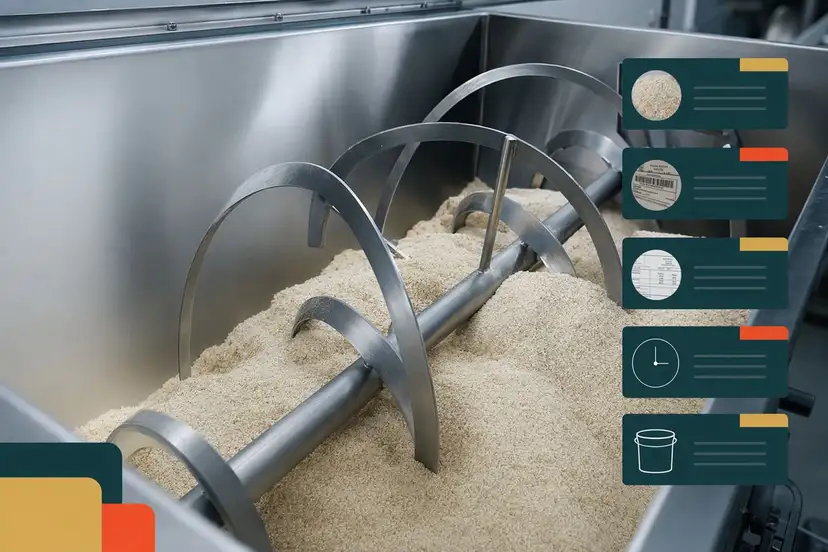
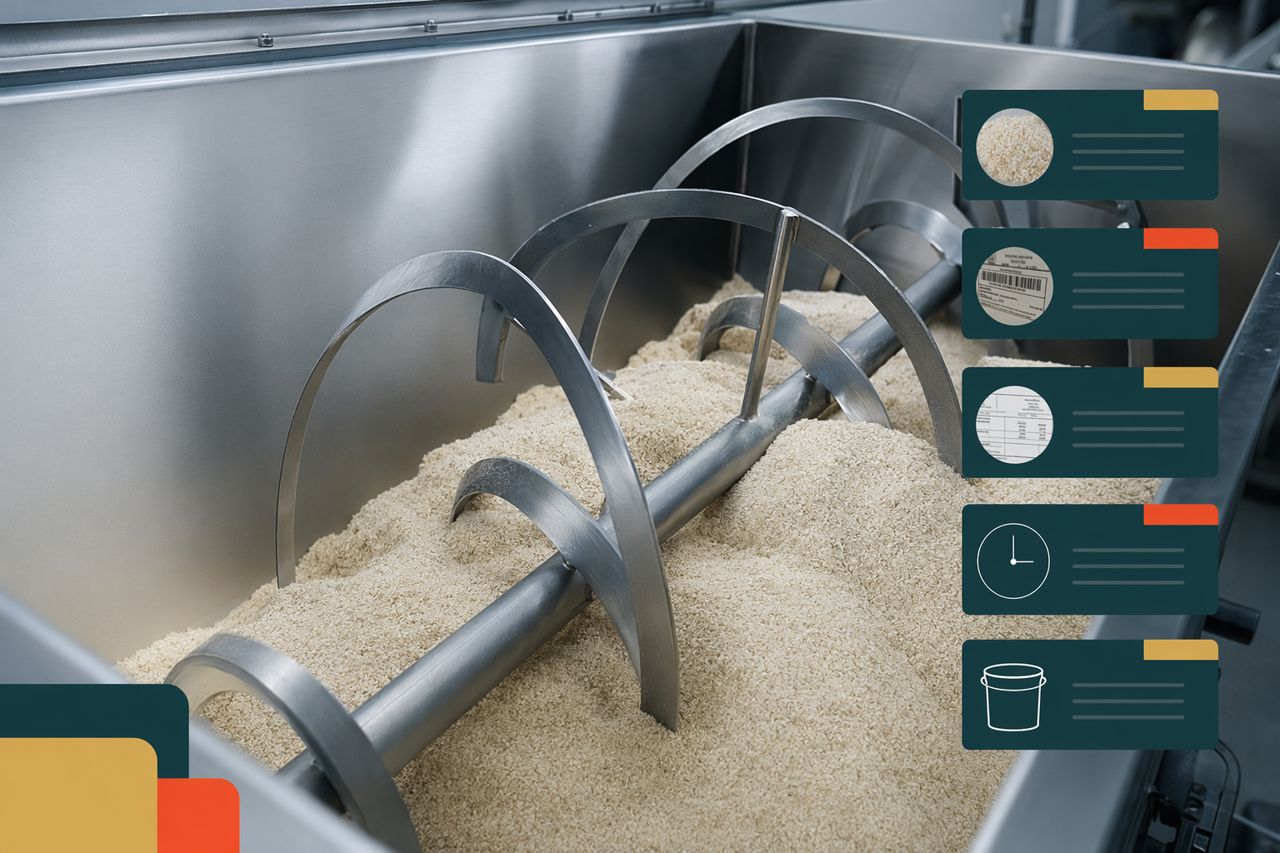
Ribbon blenders are common in dry food ingredient operations because they are flexible, familiar, and efficient for many powders. The inner and outer ribbons move material in opposing directions, creating axial and radial flow across the trough.
For enzyme premixes, ribbon systems can work well when the enzyme preparation, carrier, and base blend are compatible in particle size, bulk density, and flow behavior.
Where ribbon blenders can help
Ribbon blenders are often a practical fit when:
- the enzyme is supplied in a dry, blend-ready format
- the premix uses common carriers such as starches, flour systems, maltodextrin, salt, sugar, or other approved food-grade bases
- the blend target is a straightforward dry premix with manageable density differences
- your operation needs predictable batch economics and broad equipment compatibility
- validated customer formulas already specify ribbon blending
For procurement, the advantage is familiarity. Many contract blenders already know their ribbon fill levels, blend times, discharge behavior, cleaning procedures, and pack-out patterns. That makes it easier to evaluate a new enzyme lot against an established process window.
Where ribbon blenders can create risk
Ribbon systems can become less forgiving when the enzyme ingredient is very fine, very light, cohesive, electrostatic, or visibly different from the carrier. Risks include:
- fines accumulating in dead zones or near seals
- dust generation during charge and discharge
- over-processing of fragile carrier systems
- segregation after discharge if particle sizes are poorly matched
- longer cleanout time if the enzyme premix adheres to internal surfaces
The buyer takeaway: do not qualify a bulk enzyme only by product name. Ask how the supplier controls lot-to-lot physical presentation, carrier compatibility, moisture profile, allergen status, and documentation continuity.
Paddle blenders: faster turnover, gentler handling, different discharge behavior
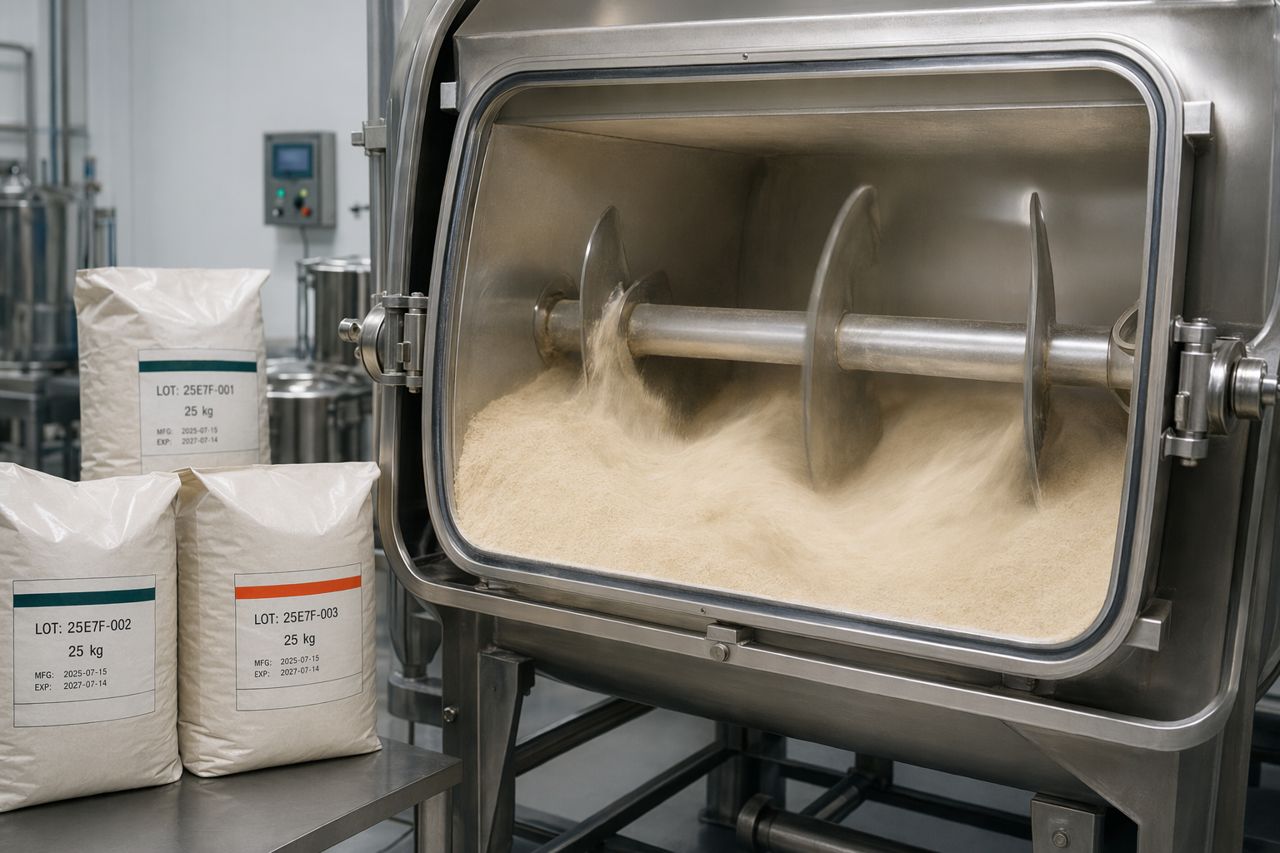
Paddle blenders move material through lifting, folding, and fluidized zones rather than the continuous sweeping action of ribbons. Depending on the machine design, this can create faster blend turnover and gentler handling for certain powders.
For enzyme premixes, paddle systems can be attractive when the formula includes sensitive minor ingredients, multiple functional powders, or ingredients with different particle behavior.
Where paddle blenders can help
Paddle blenders may be preferred when:
- the premix contains low-inclusion functional ingredients
- the blend needs rapid distribution with reduced mechanical stress
- the carrier is prone to smearing, compacting, or clumping under longer mixing
- the operation prioritizes fast discharge and short cycle times
- the formula includes ingredients with different flow properties that need controlled movement
For contract food ingredient blenders, paddle systems can support high-throughput batch planning. They can also reduce overworking in some formulations, which may help protect the physical quality of the finished premix.
Where paddle blenders can create risk
Paddle systems are not automatically safer for every enzyme premix. They can amplify other concerns:
- light enzyme powders may become airborne if charge control is weak
- high turnover can expose poor carrier selection quickly
- short mixing windows leave less room for process variation
- aggressive discharge may increase downstream segregation if the premix is not physically matched
- customer validation may be harder if the original approval was built around ribbon blending
The buyer takeaway: if you are moving from ribbon to paddle, or paddle to ribbon, treat the enzyme premix as a scale-up event. Confirm that documentation, samples, pack sizes, and lot history support the change.
Ribbon vs paddle: what procurement should compare before buying bulk enzyme
The blender decision should be tied to supplier questions. A capable enzyme supplier should help you qualify more than the ingredient name.
1. Particle compatibility
Ask whether the enzyme format is appropriate for your carrier and finished premix. Particle size, density, surface behavior, and dusting tendency can influence distribution and stability after discharge.
For ingredient blenders, the best bulk sourcing fit is usually not the cheapest line item. It is the enzyme format that stays consistent enough to protect your customer specification, batch record, and pack-out plan.
2. Carrier and label alignment
A premix buyer should confirm carrier details early. Carrier selection affects labeling, allergen review, customer formula approval, flowability, and substitution flexibility.
Procurement should ask:
- What carrier system is used?
- Is the carrier consistent across lots?
- Are alternate carriers available if supply changes?
- Will the carrier affect customer label review?
- Does the documentation support the intended food application?
Carrier changes can look minor on a quote sheet but major inside a customer approval workflow.
3. Lot traceability and documentation package
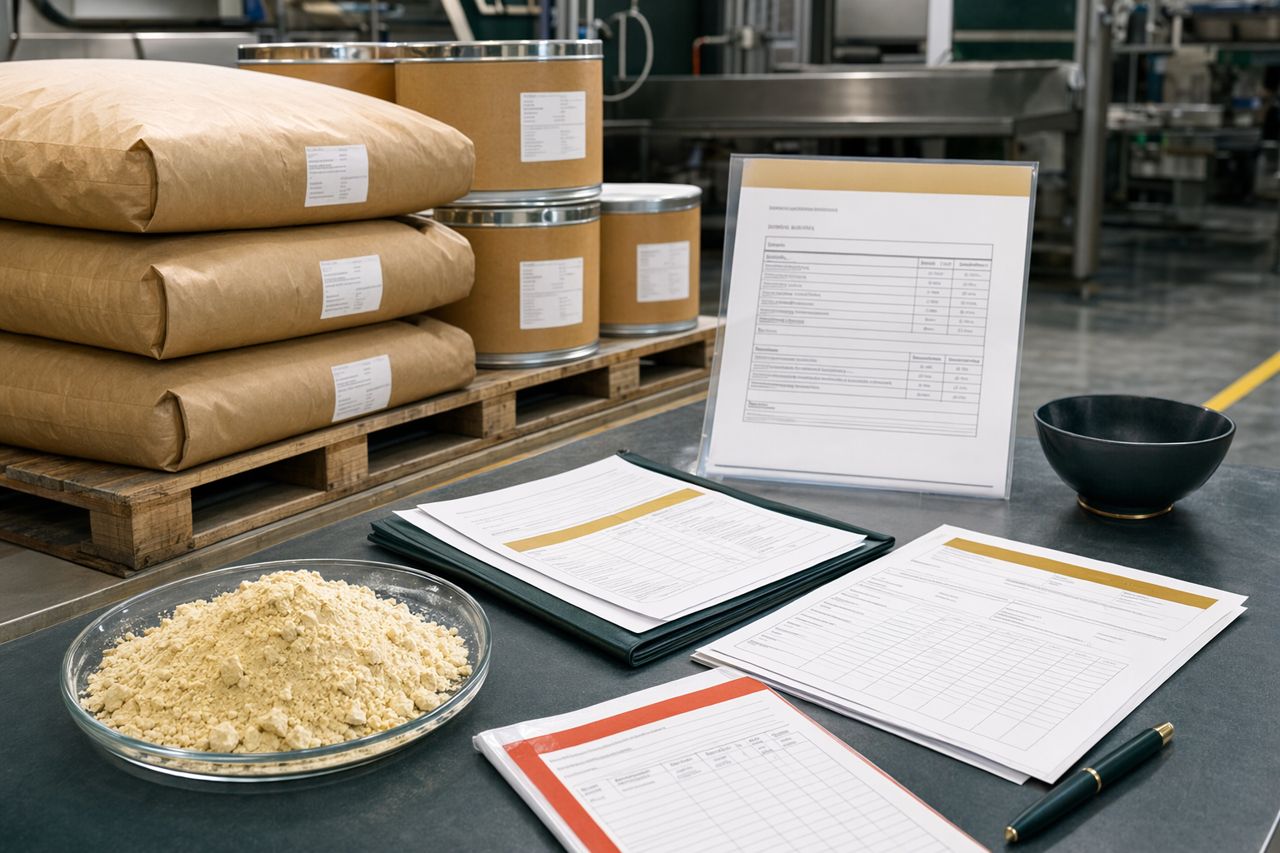
Bulk enzyme sourcing for contract blending requires documentation that moves as cleanly as the powder does.
Common buyer requirements include:
- certificate of analysis
- specification sheet
- allergen statement
- food-grade declaration
- country of origin details when required
- lot traceability
- safety data sheet when applicable
- non-GMO, halal, kosher, or other program documents when available and relevant
The question is not only whether documents exist. It is whether they are current, lot-specific where needed, and available on a timeline that supports production release.
4. Lead time and approved-supplier risk
Enzymes can become bottleneck ingredients. If your customer has approved one source, one carrier, or one documentation set, any disruption can stop production even when technically similar materials are available.
Before scaling, confirm:
- expected lead time for recurring bulk orders
- available pack sizes
- minimum order requirements
- reserve or forecast options
- substitution policy
- documentation equivalency for alternate lots
- whether samples can be matched to commercial supply
Good procurement protects the blend before the purchase order is placed.
5. Pack size and plant handling
A food enzyme that is technically correct but packaged poorly for your operation can add labor, dust, and handling risk.
Evaluate packaging against your actual process:
- bags for manual charging
- cartons or drums for controlled dispensing
- lined containers for moisture-sensitive materials
- pallet configuration for warehouse efficiency
- labeling that supports lot control and internal staging
- pack size that fits batch size without excessive partials
For contract blenders, pack size is a production variable. It affects weighing, staging, reconciliation, and sanitation planning.
When ribbon blending is the better starting point
Ribbon blending is often the more practical starting point when your operation already runs similar dry premixes, your customer approval pathway is conservative, and your ingredient set has compatible particle behavior.
Choose ribbon-first evaluation when:
- the blend base is established and free-flowing
- the enzyme is part of a broader dry ingredient system
- you need continuity with existing customer-approved processes
- your team wants predictable scale-up using familiar equipment
- your pack-out requires stable distribution across many units
In this case, supplier consistency matters more than novelty. The enzyme should arrive in a format your plant can receive, stage, blend, discharge, and document without reworking the process.
When paddle blending deserves a closer look
Paddle blending may be worth evaluating when your formula needs fast turnover, reduced mechanical exposure, or improved handling of complex powder systems.
Choose paddle evaluation when:
- the enzyme is a minor component in a multi-functional premix
- shorter blend cycles are operationally important
- your current ribbon process creates dust, heat, smearing, or long cleanout time
- the finished premix includes ingredients with varied texture or density
- your customer allows process validation with alternate equipment
The key is to avoid treating paddle blending as a universal upgrade. It is a different movement profile, and your sourcing plan should reflect that.
A practical scale-up checklist for enzyme premix buyers
Before approving a bulk enzyme purchase for ribbon or paddle blending, align your procurement, quality, and production teams around the following:
- Confirm the exact enzyme type and intended food application.
- Review the carrier, allergen status, and label implications.
- Request current documentation before production scheduling.
- Check whether sample material reflects commercial lots.
- Compare pack size against batch size and weighing workflow.
- Ask about lot consistency and change notification practices.
- Confirm lead time for repeat orders, not just first shipment.
- Identify approved alternates before an urgent substitution is needed.
- Evaluate powder behavior in the actual blender type planned for scale.
- Keep customer approval requirements visible before changing equipment or source.
What BatchLoom supports
BatchLoom helps contract food ingredient blenders source bulk food enzymes with the operational details procurement teams need before scale-up. We focus on supply fit, documentation readiness, lot continuity, and practical pack formats for blending environments.
We can support discussions around enzyme type, dry premix use, supplier documentation, carrier considerations, lead times, and quote planning for recurring volume.
Request a quote for your enzyme premix program
If you are comparing ribbon and paddle blending for an enzyme premix, bring the sourcing question into the process early.
Use the on-site request a quote form and include:
- enzyme type or intended function
- target food application
- current or planned blender type
- preferred pack size
- estimated order volume
- required documentation
- allergen or certification requirements
- desired lead time
BatchLoom will review the request and respond with a bulk sourcing path that fits your approval workflow, production schedule, and customer documentation needs.